
Summary description
This research focuses on the generation and propagation of ultrasonic waves in thin films and multilayer materials using pulsed laser irradiation (ns, ps, fs). We develop advanced experimental techniques (pump-probe interferometry) and multiphysics computational models to investigate ultrasound generation mechanisms, evaluate the performance of different materials as transducers (e.g., Ta, Ti, Au), and apply the findings to non-destructive material testing.
Keywords: Laser-Generated Ultrasound, Surface Acoustic Waves (SAWs), Pump-Probe Interferometry, Finite Element Method (FEM), Two-Temperature Model (TTM), Photoacoustic Transduction
Detailed overview
Laser-generated ultrasound is a powerful tool for material characterization and modification. Our research group develops and applies an integrated methodology combining high-precision experiments and advanced computational simulations to study these phenomena.
Experimental Approach
We employ pump-probe interferometry techniques to generate and simultaneously record the evolution of SAWs. A “pump” pulse excites the sample, while a second, time-delayed “probe” pulse records the surface deformation via Michelson interferometry. This setup enables:
- High resolution: The method offers lateral resolution ~1 μm and out-of-plane resolution ~1 nm, allowing real-time monitoring of wave propagation.
- Brillouin detection: In thin films, Brillouin oscillations in the reflectivity signal provide information on the amplitude and velocity of acoustic pulses within the substrate.
- Use of different laser sources for pump and probe pulses.
Computational Approach
To understand and predict material behavior, we develop advanced computational models using the Finite Element Method (FEM). These models simulate:
- The propagation of acoustic waves, considering non-linear phenomena, plastic deformation, and phase changes (melting, ablation).
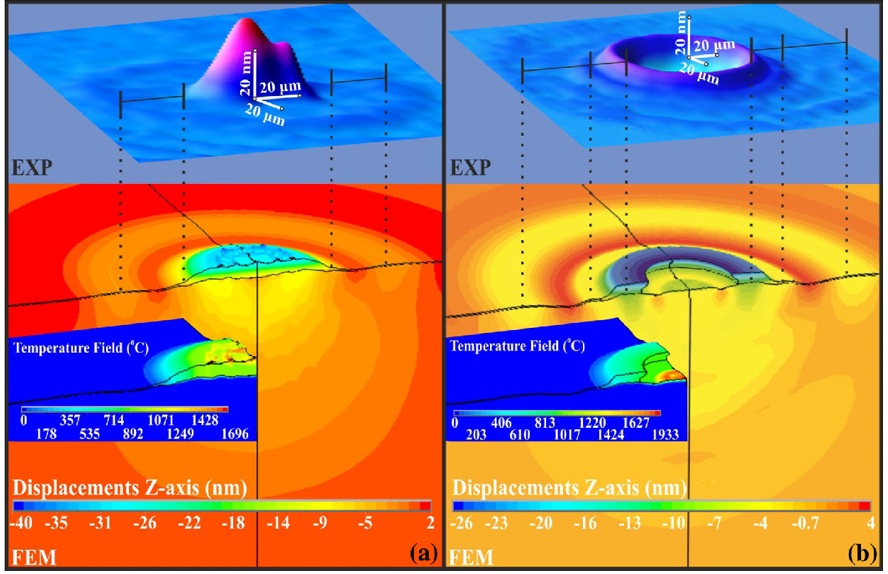
- The interaction of waves with inhomogeneities (surface cracks, material boundaries).
- In the case of fs pulse excitation, the simulations incorporate the Two-Temperature Model (TTM), which describes the initial excitation and heating of electrons, as well as the energy transfer to the lattice via electron-phonon coupling.
Applications and Key Findings
Transducer Material Evaluation: We compared the performance of thin Ta, Ti, and Au films. Ta emerges as an excellent transducer, generating stronger acoustic strains in Si compared to Ti, due to its high Young’s modulus and favorable elastic behavior.
Non-Destructive Testing: We demonstrated that fs-laser-generated SAWs have a shallow penetration depth (<15 μm) and are ideal for detecting surface defects (e.g., cracks), in contrast to ns-laser-generated SAWs which probe deeper.
Examples:
Comparison of Ta vs. Ti as Photoacoustic Transducers.
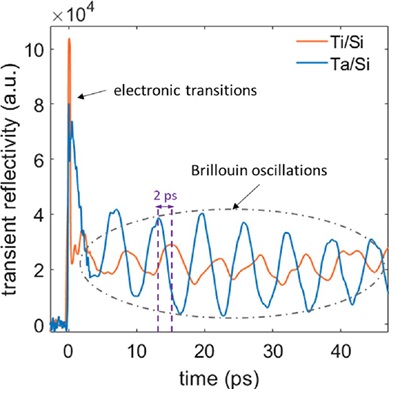
The modulation depth of the Brillouin oscillations is directly related to the amplitude of the induced phonon, and the experimentally measured transient reflectivity is used to evaluate the properties of the photoacoustic transducers.
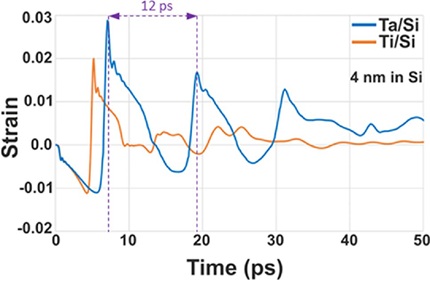
Computational prediction of the temporal evolution of strain in Ta/Si and Ti/Si systems.
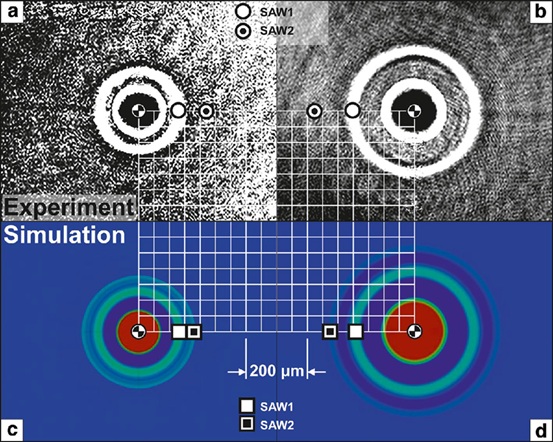
Evolution of SAWs in a thin Au film. Excellent agreement between experimental and computational recording of the radial propagation of SAWs (concentric rings) at 25 ns.
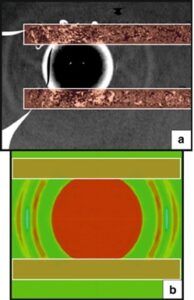
Surface Defect Detection. Surface acoustic waves on an Au sample of 500 nm thickness with defects of 15 μm depth, at 122 ns, observed experimentally (a) and numerically (b).
Selected publications
Kaleris, K., Kaniolakis-Kaloudis, E., Kaselouris, E., Kosma, K., Gagaoudakis, E., Binas, V., Petraklis, S., Dimitriou, V., Bakarezos, M., Tatarakis, M., Papadogiannis, N.A. (2023). Efficient ultrafast photoacoustic transduction on Tantalum thin films. Applied Physics A, 129, 550. https://doi.org/10.1007/s00339-023-06797-6
Kosma, K., Kaleris, K., Kaselouris, E., Kaniolakis-Kaloudis, E., Petrakis, S., Orphanos, Y., Gagaoudakis, E., Binas, V., Bakarezos, E., Tatarakis, M., Dimitriou, V., Papadogiannis, N.A. (2023). Pump-probe reflectivity studies of ultrashort laser-induced acousto-mechanical strains in ZnO films. Applied Physics A, 129, 597. https://doi.org/10.1007/s00339-023-06837-1
Orphanos, Y., Kosma, K., Kaselouris, E., Vainos, N., Dimitriou, V., Bakarezos, M., Tatarakis, M., Papadogiannis, N.A. (2019). Integrated nanosecond laser full-field imaging for femtosecond laser-generated surface acoustic waves in metal film-glass substrate multilayer materials. Applied Physics A, 125, 269. https://doi.org/10.1007/s00339-019-2552-6
Bakarezos, M., Tzanaki, E., Petraki, S., Tsibidis, G., Loukakos, P.A., Dimitriou, V., Kosmidis, C., Tatarakis, M., Papadogiannis, N.A. (2018). Ultrafast laser pulse chirp effects on laser-generated nanoacoustic strains in Silicon. Ultrasonics, 86, 14-19. https://doi.org/10.1016/j.ultras.2018.01.008
Tzianaki, E., Bakarezos, M., Tsibidis, G.D., Orphanos, Y., Loukakos, P.A., Kosmidis, C., Patsalas, P., Tatarakis, M., Papadogiannis, N.A. (2015). High acoustic strains in Si through ultrafast laser excitation of Ti thin-film transducers. Optics Express, 23(13), 17191-17204. https://doi.org/10.1364/OE.23.017191
Dimitriou, V., Kaselouris, E., Orphanos, Y., Bakarezos, M., Vainos, N., Nikolos, I.K., Tatarakis, M., Papadogiannis, N.A. (2015). The thermo-mechanical behavior of thin metal films under nanosecond laser pulse excitation above the thermoelastic regime. Applied Physics A, 118, 739-748. https://doi.org/10.1007/s00339-014-8792-6