
Summary Description
This research focuses on the generation of optically shaped gaseous targets through the interaction of nanosecond laser pulses with high-density gas-jet profiles, enabling proton acceleration in the near-critical density regime via Magnetic Vortex Acceleration (MVA). We develop an integrated methodology combining advanced experimental diagnostics (Mach-Zehnder interferometry, shadowgraphy) and multiphysics computational simulations (3D MHD with FLASH, 3D PIC with EPOCH) to study blast wave collisions, target density profile optimization, and subsequent proton acceleration from TW-class femtosecond laser systems.
Keywords: magnetic vortex acceleration, blast waves, near-critical density plasma, proton acceleration, gas jet targets, MHD simulations, PIC simulations, optical shaping
Detailed Overview
The study of laser-driven ion acceleration is a fundamental research topic with critical applications in inertial confinement fusion (proton-driven fast ignition), hadron therapy, and high-energy density physics. Gas targets offer a promising alternative to solid targets for high repetition rate, debris-free operation, but require precise density profile control to reach the near-critical density regime. Our research group develops and applies an integrated methodology combining high-precision experiments and advanced computational models to optically shape gas jet targets via colliding blast waves and study proton acceleration via Magnetic Vortex Acceleration.
Experimental Approach
We employ a high-pressure gas delivery system comprising a Haskel air-driven hydrogen gas booster (up to 1000 bar backing pressure) and a Clark Cooper solenoid valve, coupled with custom-designed conical nozzles (400 μm diameter). For optical shaping, a 1064 nm, 6 ns, 835 mJ Nd:YAG laser is split into multiple beams and focused onto the gas jet to generate Sedov-type blast waves. The accelerating pulse is provided by the ZEUS 45 TW Ti:Sa laser system (800 nm, 25 fs, 1.1 J, a₀ ~14). Diagnostics include:
-
Mach-Zehnder Interferometry: Electron density measurement via fringe shift analysis
-
Shadowgraphy: Visualization of shock front dynamics and compression region
-
CR39 Nuclear Track Detectors: Ion energy spectrum measurement with multilayer filter mask (1.0-11.3 MeV/u)
-
Radiochemical Film (RCF): Dose distribution of ions and electrons
Computational Approach
To understand and predict target shaping and acceleration, we develop advanced multiphysics computational models:
3D MHD Simulations (FLASH code): Modeling of blast wave generation and collision, considering:
-
Sedov self-similar blast wave dynamics
-
Ray tracing for multiple laser pulses
-
Tabulated equation of state (IONMIX4) with temperature-density grid
-
5% initial ionization for laser energy coupling
-
Adaptive mesh refinement (AMR level 5, cell size ~1.5×1.2×1.5 μm)
-
Outflow boundary conditions for shock propagation
3D PIC Simulations (EPOCH code): Modeling of MVA proton acceleration, considering:
-
Field ionization module (H ionization energy 13.6 eV)
-
Boris pusher and Yee solver with Villasenor-Buneman current deposition
-
4-5th order particle shape functions
-
4 macroparticles per cell
Applications and Key Findings
Optical Shaping via Blast Wave Collisions
-
Single Blast Wave: Compression factor C = 3.7 (near strong shock limit C=4 for γ=1.67), FWHM = 15.8 μm, peak density 0.16 ncr
-
Dual Parallel BWs: C = 6.4, FWHM = 11.5 μm, peak density 0.30 ncr, compression sustained for ~600 ps
-
Dual Intersecting BWs (60°): C = 10.8, scale length ls = 8.0 μm (Z-axis) and 9.6 μm (X-axis), compression maintained >2.5 ns, no low-density pedestal
-
Triple Intersecting BWs: C = 13.4, peak density 0.64 ncr, ls = 19.0 μm
-
Quadruple Perpendicular Intersecting BWs: C = 24.8, peak density 1.15 ncr, ls = 6.8 μm, compression sustained ~200 ps
Proton Acceleration via Magnetic Vortex Acceleration
-
Optimal conditions: Peak electron density ~0.5-0.75 ncr with scale length ls = 8-10 μm
-
Proton cut-off energies: 8-14 MeV (2D PIC), up to 16.5 MeV (3D PIC for quadruple intersecting configuration)
-
Quasi-monoenergetic peak: ~6 MeV/u observed experimentally
-
Magnetic vortex field: By > 2×10⁴ T (up to 5×10⁴ T in simulations)
-
Longitudinal accelerating field: Ex ~5×10¹² V/m
-
Laser energy coupling efficiency: >48% to plasma
-
Proton beam collimation: Half-angle 30° (protons), 20° (helium ions)
ASE Effects
Amplified spontaneous emission (ASE) from the main accelerating pulse (intensity contrast ~10⁶) steepens the density profile from 40 μm to 23 μm at 1/e of peak density, beneficially enhancing the near-critical density gradient.
Examples
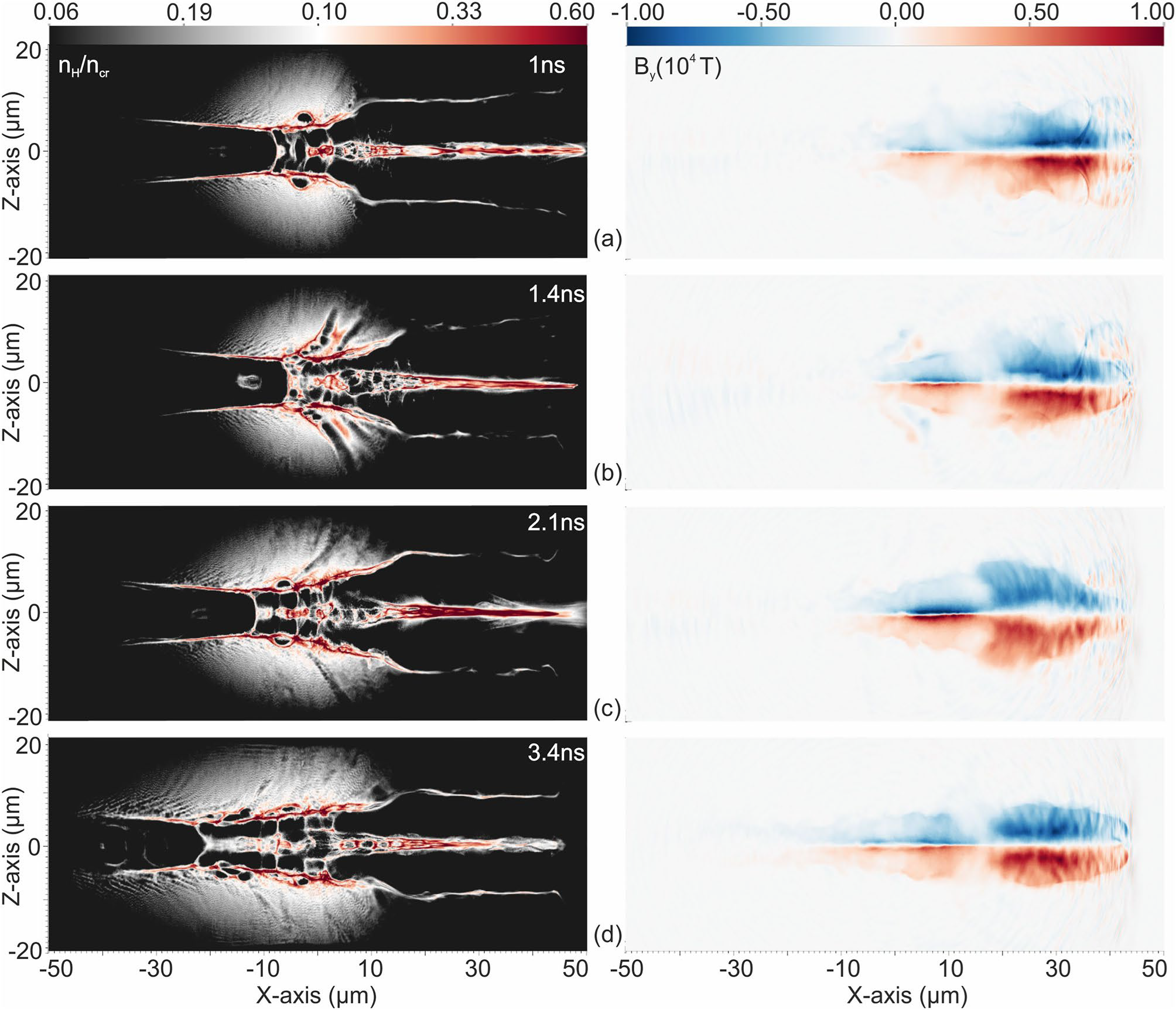
PIC simulation results of the four near critical density target profiles by the two intersecting ns laser pulses set-up, at 1.0 (a), 1.4 (b), 2.1 (c) and 3.4 ns (d), interacting with the 45TW, 23 fs Zeus laser pulse (left) and the corresponding azimuthal magnetic fields.
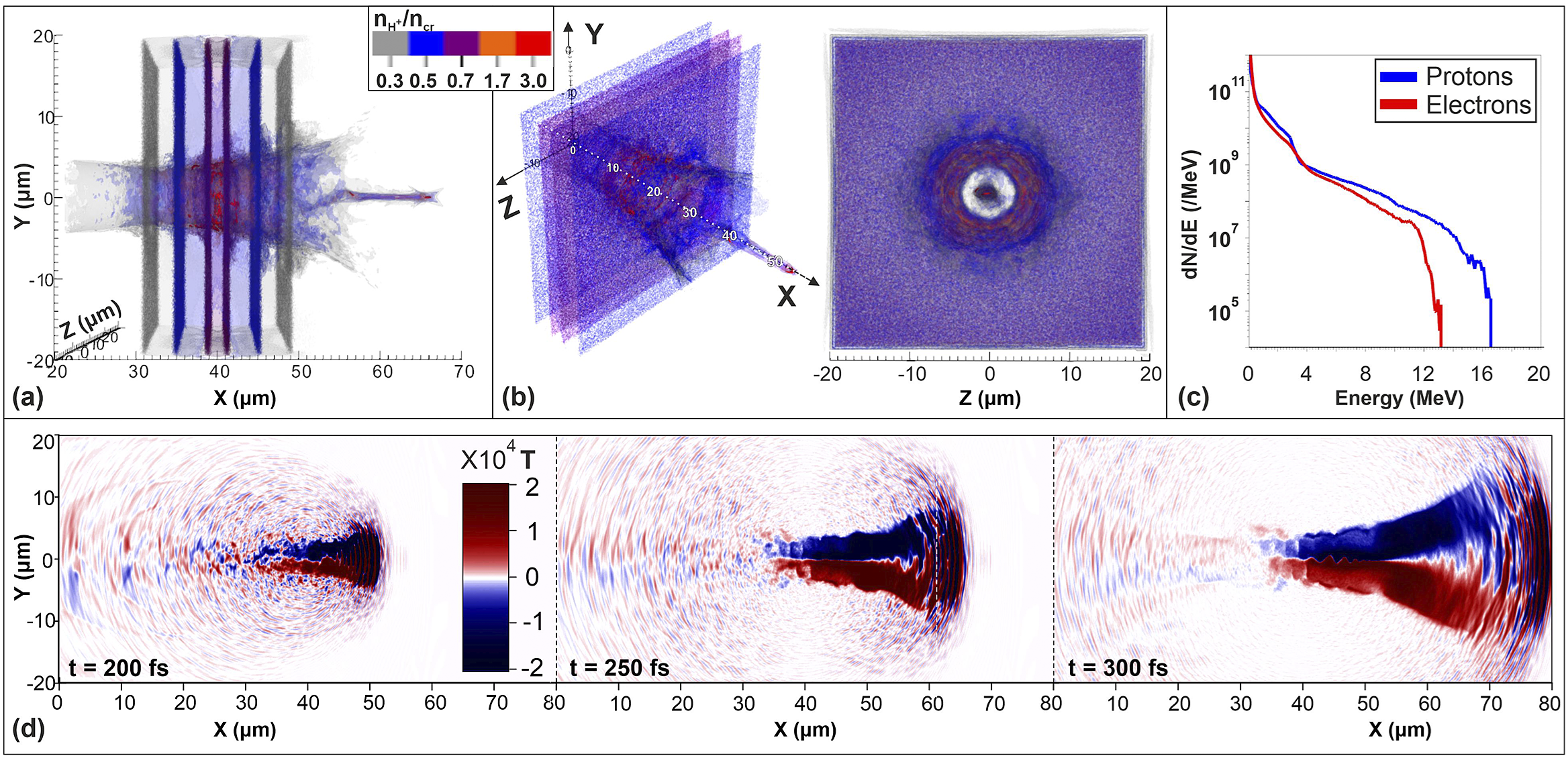
MVA simulation results where the ZEUS laser interacts with quadruple pulse profiles. Panels a and b visualize the ionized density, while panel c shows the energy spectra with a proton cut-off of 16.5 MeV. The sequence in panel d maps the evolution of the azimuthal magnetic field, illustrating the vortex development.
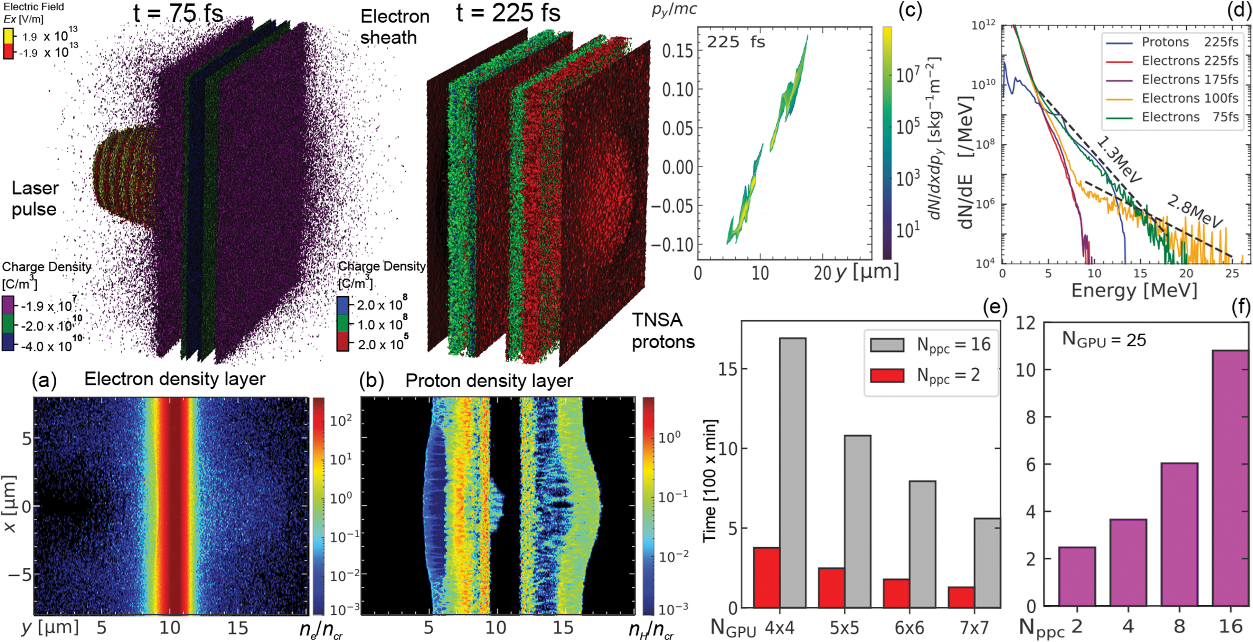
3D TNSA (Target Normal Sheath Acceleration) simulation results performed on GPUs. It showcases the evolution of electron and proton densities (panels a and b) alongside their energy spectra and phase space (panels c and d), demonstrating how high-intensity laser pulses accelerate protons. Panels e and f highlight the computational performance, showing the simulation’s scalability across multiple GPUs and PIC configurations.
Selected publications
Tazes, I., Passalidis, S., Andrianaki, G., Skoulakis, A., Karvounis, C., Mancelli, D., Pasley, J., Kaselouris, E., Fitilis, I., Bakarezos, M., Benis, E.P., Papadogiannis, N.A., Dimitriou, V., Tatarakis, M. (2026). Laser-driven ion acceleration in long-lived optically shaped gaseous targets enhanced by magnetic vortices. (accepted in Physical Review Research)
Tazes, I., Passalidis, S., Kaselouris, E., Mancelli, D., Karvounis, C., Skoulakis, A., Fitilis, I., Bakarezos, M., Papadogiannis, N.A., Dimitriou, V., Tatarakis, M. (2024). Efficient Magnetic Vortex Acceleration by femtosecond laser interaction with long living optically shaped gas targets in the near critical density plasma regime. Scientific Reports, 14, 4945. https://doi.org/10.1038/s41598-024-54475-1
Tazes, I., Passalidis, S., Kaselouris, E., Fitilis, I., Bakarezos, M., Papadogiannis, N.A., Tatarakis, M., Dimitriou, V. (2022). A computational study on the optical shaping of gas targets via blast wave collisions for magnetic vortex acceleration. High Power Laser Science and Engineering, 10, e31. https://doi.org/10.1017/hpl.2022.16
Tazes, I., Andrianaki, G., Grigoriadis, A., Passalidis, S., Skoulakis, A., Kaselouris, E., Vrouvaki, E., Chatzakis, J., Fitilis, I., Bakarezos, M., Benis, E.P., Dimitriou, V., Papadogiannis, N.A., Tatarakis, M. (2022). Optical shaping of high-pressure gas-jet targets for proton acceleration experiments in the near-critical density regime. 48th EPS Conference on Plasma Physics, P2b.208
Tazes, I., Ong, J.F., Tesileanu, O., Tanaka, K.A., Papadogiannis, N.A., Tatarakis, M., Dimitriou, V. (2020). Target normal sheath acceleration and laser wakefield acceleration particle-in-cell simulations performance on CPU & GPU architectures for high-power laser systems. Plasma Physics and Controlled Fusion, 62, 094005. https://doi.org/10.1088/1361-6587/aba17a
Passalidis, S., Ettlinger, O.C., Hicks, G.S., Dover, N.P., Najmudin, Z., Benis, E.P., Kaselouris, E., Papadogiannis, N.A., Tatarakis, M., Dimitriou, V. (2020). Hydrodynamic computational modelling and simulations of collisional shock waves in gas jet targets. High Power Laser Science and Engineering, 8, e7. https://doi.org/10.1017/hpl.2020.5