Summary description:
This research focuses on the creation and dynamic evolution of plasma in low-current X-Pinch devices. We develop an integrated methodology combining advanced experimental optical diagnostics (three-frame shadowgraphy, interferometry) and multiphysics MHD computational simulations (GORGON, PLUTO) to study plasma evolution, plasma jet formation, hot spot generation, and X-ray production for high-resolution radiography applications.
Keywords: X-pinch plasmas, magnetohydrodynamic simulations, plasma jets, X-ray radiography, optical probing diagnostics, plasma instabilities
Detailed overview
The study of X-Pinch plasmas is a fundamental research topic with significant applications in high-resolution radiography of biological samples, dense plasma imaging, and laboratory astrophysics. Our research group develops and applies an integrated methodology combining high-precision experiments and advanced MHD computational models to study the dynamic evolution of plasma from initial expansion to jet formation and X-ray production.
Experimental Approach
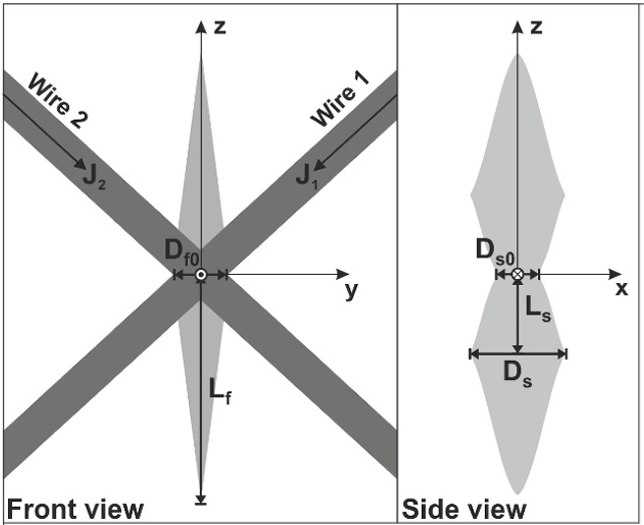
We employ a low-current (45 kA, 50 ns rise time) X-Pinch device to heat thin tungsten (W) or gold-plated tungsten (Au-plated W) wires of 5 μm diameter. We developed multi-channel optical probing diagnostics for simultaneous recording of plasma temporal evolution:
-
Three-frame Shadowgraphy: Qualitative and quantitative evaluation of plasma instabilities and jet formation.
-
Three-frame Mach-Zehnder Interferometry: Measurement of areal electron plasma density.
-
Point-projection Radiography: Imaging of internal structures of samples with ~40 μm resolution.
-
Filtered PIN Diodes (Al and Cu filters): Time-resolved soft X-ray emission measurements.
Computational Approach
To understand and predict plasma behavior, we develop advanced MHD computational models:
-
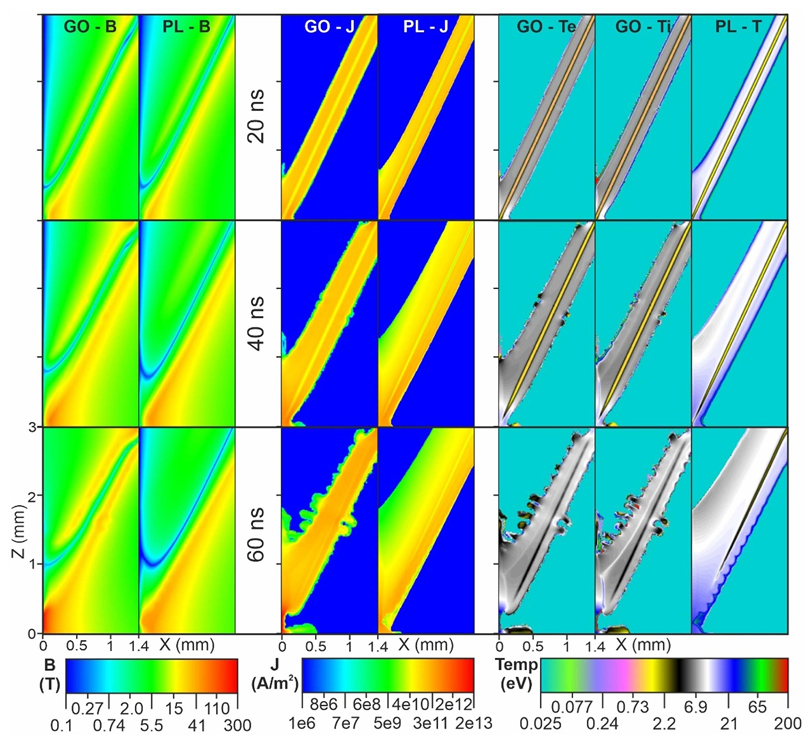
PLUTO (Modular MHD Code): Simulation with single-fluid approximation, including:
-
SESAME equations of state for tungsten and air
-
Radiation transport and optically thin losses
-
Electrical resistivity models (linear mixture, Spitzer/10)
-
Multi-material mixing for plasma-vacuum interface
-
-
GORGON (Eulerian MHD Code): Simulation of plasma dynamic evolution with separate treatment of ions and electrons, considering:
-
Conservation laws of mass, momentum, and energy
-
Induction equation with displacement current for magnetic field calculation
-
Spitzer resistivity and Joule heating
-
Optically thin plasma radiation losses
-
Applications and Key Findings
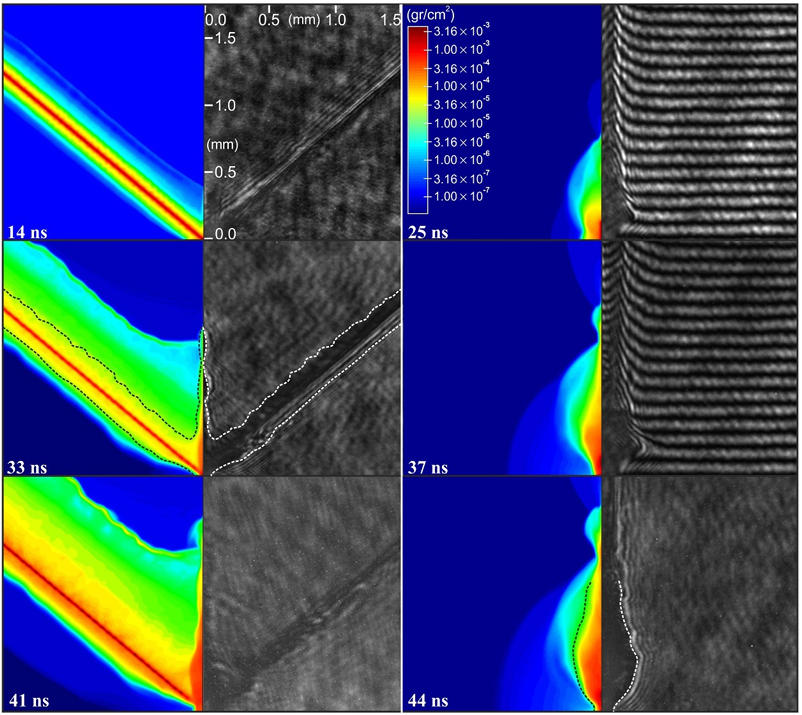
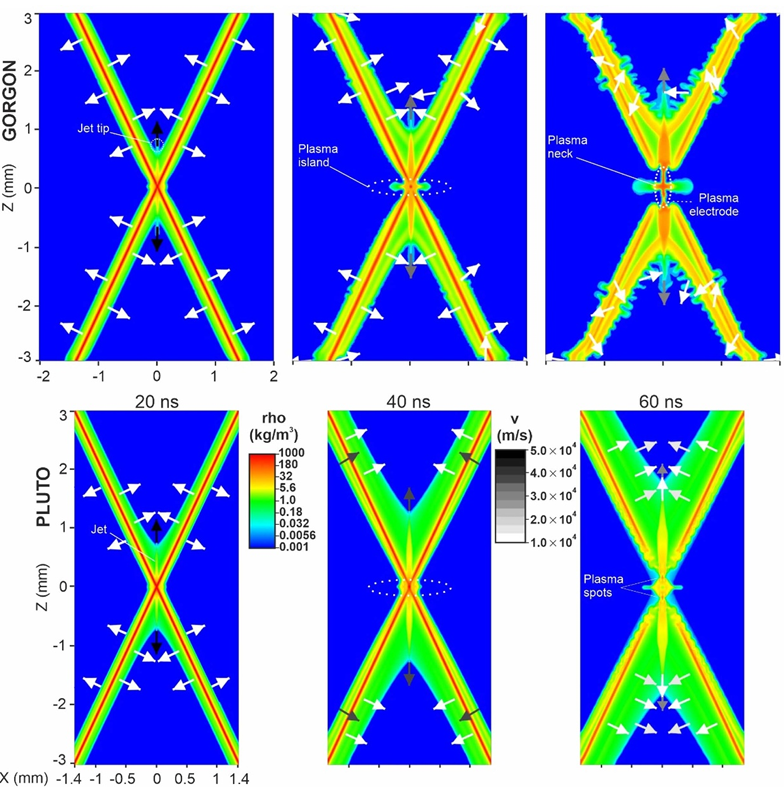
Plasma Jet Formation: Simulations revealed that jet formation results from combined action of plasma expansion from the cross-point region and continuous plasma ablation from the X legs. Jet velocity reaches 39 km/s (Mach 4), with the “zippering” mechanism playing a crucial role.
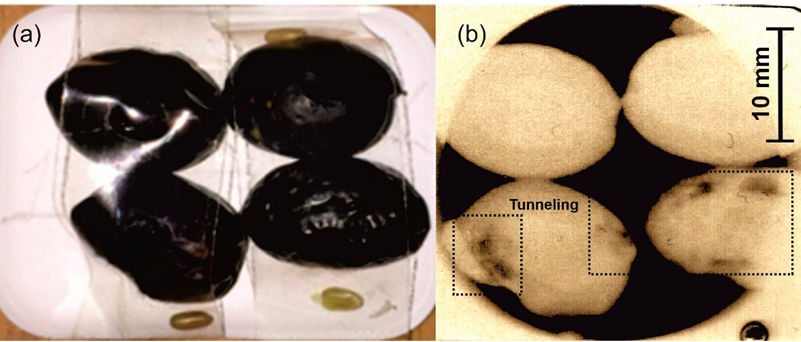
Biological Sample Radiography: The portable X-Pinch device was used for radiography of olive samples, revealing extensive damage from Bactrocera oleae insect with ~40 μm resolution.
Influence of Physical Parameters: Study of electrical resistivity, radiation transport, and optically thin losses showed that radiation transport reduces instability growth rate, while optically thin losses lead to intense Magneto-Rayleigh-Taylor (MRT) instability development with double magnetic field values.
Examples
Comparison between simulated and experimental results of the areal mass density evolution for front and side views in an X-pinch setup.
Biological Sample Radiography. Point-projection radiography application for detection of damage in olive samples.
Temporal Evolution of X-Pinch Plasma. Comparative results of GORGON and PLUTO simulations for plasma density distribution on a slice through the plane of the wires.
Magnetic Field and Temperature Distribution. Comparison of GORGON and PLUTO results for magnetic field, current density, and temperature.