
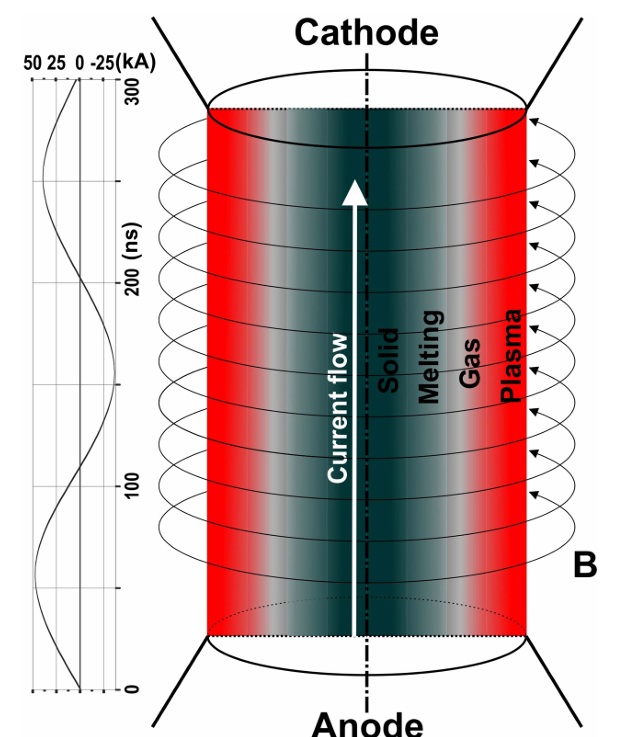
Summary description:
This research focuses on the study of plasma instability seeding mechanisms in Z-Pinch configurations through the investigation of the solid-to-plasma phase transition. We develop an integrated methodology combining advanced experimental optical diagnostics (shadowgraphy, interferometry, schlieren) and multiphysics computational simulations (FEM-BEM-MHD) to study the generated Electro-Thermo-Mechanical (ETM) instability in the solid phase, which acts as a seed for the Magnetohydrodynamic (MHD) instabilities later developed in the plasma phase.
Keywords: Z-pinch plasmas, plasma instabilities, electro-thermo-mechanical instability, magnetohydrodynamic instabilities, multiphysics simulations, optical probing diagnostics
Detailed overview
The study of plasma instabilities is a fundamental research topic with critical applications in Magnetized Liner Inertial Fusion and Inertial Confinement Fusion. Our research group develops and applies an integrated methodology combining high-precision experiments and advanced computational models to study plasma instability seeding mechanisms from the solid phase of matter.
Experimental Approach
We employ a current of 40-50 kA Z-Pinch device with 60 ns rise time to heat metallic wires (Cu, Ag) of 250-300 μm diameter and 5-15 mm length. We developed multi-channel optical probing diagnostics using 150 ps laser pulses at 532 nm for simultaneous recording of material evolution from solid to plasma phase:
-
Modified Fraunhofer Diffraction: Wire expansion measurement with ~1 μm spatial resolution before plasma formation.
-
Shadowgraphy: Qualitative and quantitative evaluation of plasma instabilities through second-order density gradients.
-
Schlieren Imaging: Discrimination between neutral gas and plasma using a knife-edge aperture.
-
Mach-Zehnder Interferometry: Measurement of plasma electron density.
Computational Approach
To understand and predict material behavior, we develop advanced multiphase, multiphysics computational models:
-
FEM-BEM Model (LS-DYNA): Simulation of electro-thermo-mechanical behavior from solid phase to plasma, considering:
-
Maxwell equations with eddy-current approximation
-
Lorentz force and Joule heating
-
Thermo-elastoplastic behavior (Johnson-Cook model)
-
Equations of State (Gruneisen and Burgess)
-
Temperature-dependent material properties
-
-
Coupling with MHD Code (GORGON/PLUTO): Density and temperature results from FEM are used as initial conditions for studying plasma evolution and MHD instabilities.
Applications and Key Findings
Discovery of ETM Instability: We demonstrated for the first time that incorporating the real thermo-elasto-plastic properties of the solid material is catalytic for understanding instabilities developing before plasma formation. We named this instability Electro-Thermo-Mechanical (ETM) instability.
Analytical ETM Instability Model: We developed an analytical dispersion relation describing the ETM instability growth rate in the elastic region, considering the full thermoelastic Cauchy stress tensor.
Effect of Coatings: We showed that adding a 13 μm polyimide dielectric coating to a Cu wire reduces the ETM instability amplitude by 3.5 times and leads to suppression of MHD instabilities in the plasma phase.
Wavelength Correlation: The developing wavelengths of ETM instability in the solid phase (225-350 μm) lie in the same range as the initial wavelengths of MHD instabilities in the plasma, confirming ETM’s role as a seeding mechanism.
Examples
Electro-Thermo-Mechanical instability
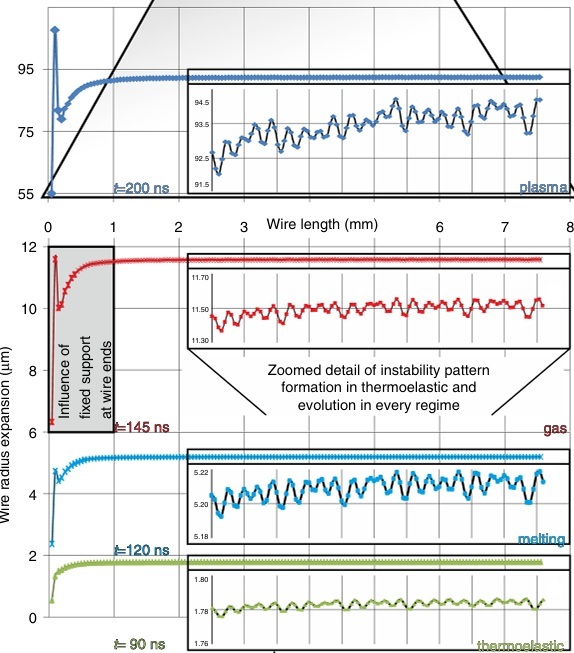
Instability formation in the thermoelastic regime and its evolution through each distinct phase up to the plasma stage.
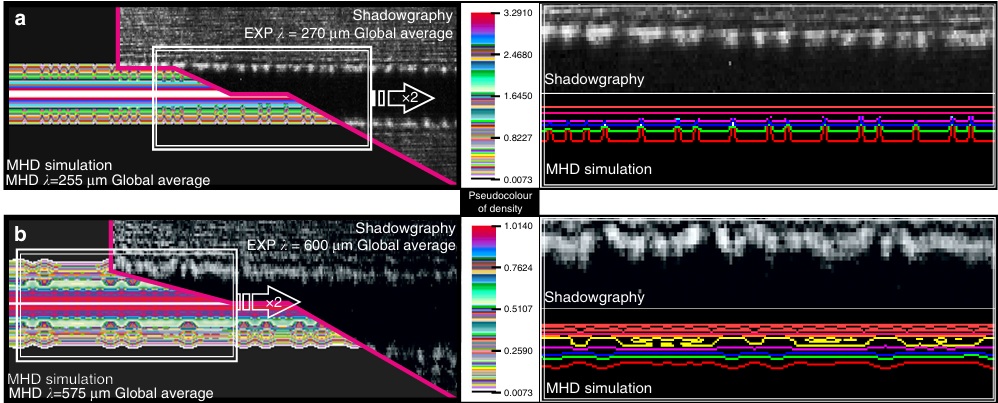
Experimental results versus magnetohydrodynamic simulation results in the plasma phase. The wavelength of the corona plasma disturbances increases over time.
Comparison of Bare Cu vs. Polyimide-coated Cu. The dielectric coating drastically reduces instability growth in the plasma phase, as shown in experimental shadowgraphy and simulation results.
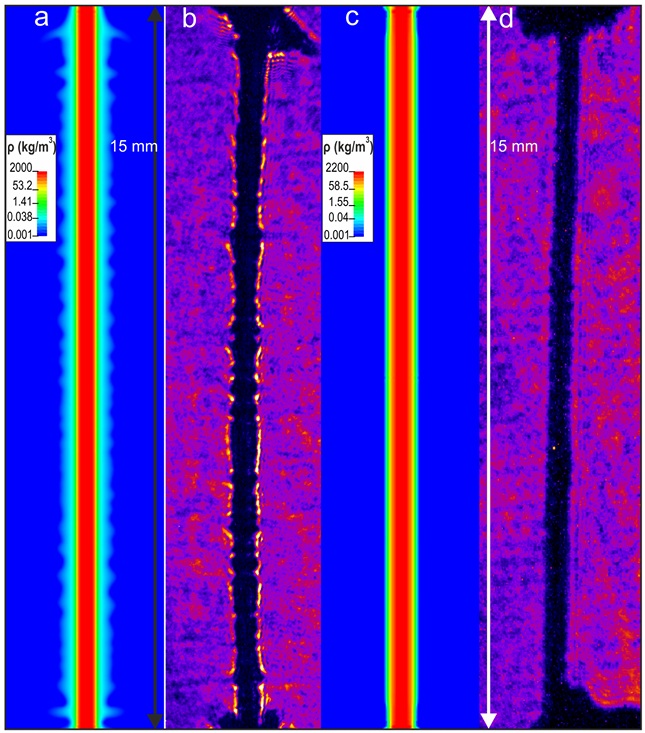
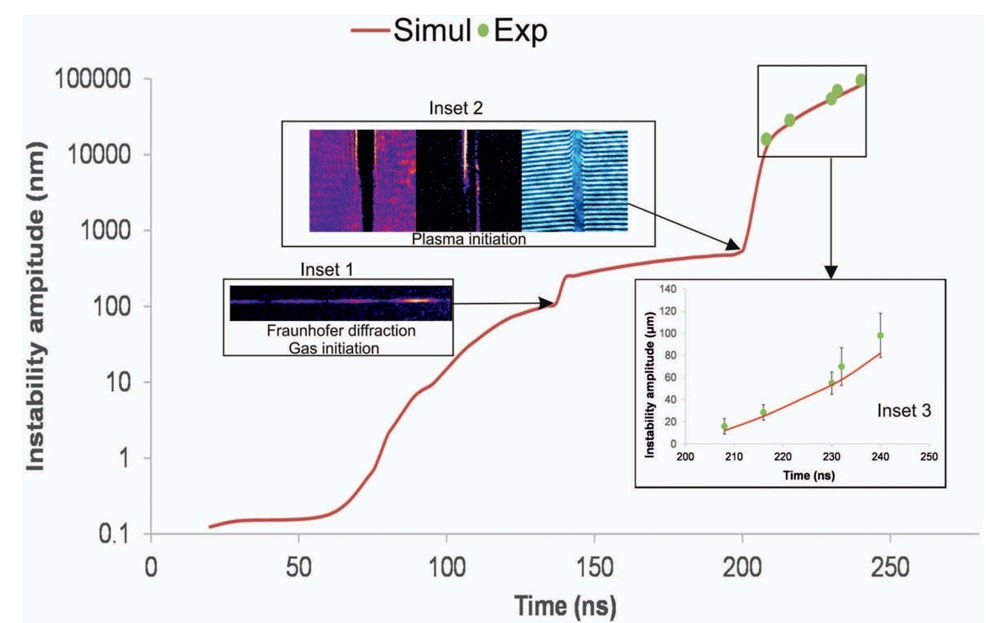
Instability Evolution from Solid to Plasma. First complete recording of instability amplitude evolution from solid to plasma phase.
Selected Publications
Kaselouris, E., Skoulakis, A., Fitilis, I., Chatzakis, J., Clark, E.L., Dimitriou, V., Papadogiannis, N.A., Tatarakis, M. (2022). A study on the electro-thermo-mechanical instability as a seed for the magneto-hydrodynamic instabilities. Plasma Physics and Controlled Fusion, 64, 105008. https://doi.org/10.1088/1361-6587/ac8829
Kaselouris, E., Tamiolakis, G., Dimitriou, V., Tatarakis, M. (2021). The influence of the load’s geometrical characteristics on the generation of the electro-thermo-mechanical instability in a single wire Z-pinch. Journal of Physics: Conference Series, 1730, 012092. https://doi.org/10.1088/1742-6596/1730/1/012092
Kaselouris, E., Tamiolakis, G., Fitilis, I., Skoulakis, A., Dimitriou, V., Tatarakis, M. (2021). Instability growth mitigation study of a dielectric coated metallic wire in a low current Z-pinch configuration. Plasma Physics and Controlled Fusion, 63, 085010. https://doi.org/10.1088/1361-6587/ac05f4
Kaselouris, E., Dimitriou, V., Fitilis, I., Skoulakis, A., Koundourakis, G., Clark, E.L., Bakarezos, M., Nikolos, I.K., Papadogiannis, N.A., Tatarakis, M. (2017). The influence of the solid to plasma phase transition on the generation of plasma instabilities. Nature Communications, 8, 1713. https://doi.org/10.1038/s41467-017-02000-6
Kaselouris, E., Fitilis, I., Skoulakis, A., Koundourakis, G., Clark, E.L., Chatzakis, J., Bakarezos, M., Papadogiannis, N.A., Dimitriou, V., Tatarakis, M. (2018). Preliminary investigation on the use of low current pulsed power Z-pinch plasma devices for the study of early stage plasma instabilities. Plasma Physics and Controlled Fusion, 60, 014031. https://doi.org/10.1088/1361-6587/aa904b
Fitilis, I., Skoulakis, A., Kaselouris, E., Nikolos, I.K., Bakarezos, E., Papadogiannis, N.A., Dimitriou, V., Tatarakis, M. (2015). Diagnosing the initial stages from solid to plasma phase for dense plasma explosions. Proceedings of Science, (ECPD2015), 127. https://pos.sissa.it/240/127/pdf