
Summary Description
This research focuses on the generation and optimization of relativistic electron beams and betatron-type X-ray radiation via Laser Wakefield Acceleration (LWFA). We develop an integrated methodology combining advanced experimental diagnostics (magnetic spectrometry, interferometry, shadowgraphy, X-ray imaging) and high-performance PIC computational simulations to study the dynamics of plasma bubble formation, electron injection mechanisms, and acceleration processes. Key parameters investigated include laser pulse contrast, gas target species and density profile, and laser pulse chirp, enabling control over electron beam energy, charge, divergence, and stability for applications in radiation dosimetry, material science, and biomedical research.
Keywords: laser wakefield acceleration, relativistic electron beams, betatron radiation, plasma bubble, ionization injection, laser chirp, gas jet targets, PIC simulations
Detailed Overview
Laser Wakefield Acceleration is a revolutionary method for generating relativistic electron beams using ultra-intense, ultra-short laser pulses interacting with gaseous targets. LWFA has become a compact alternative to conventional radio-frequency accelerators, offering GV/m accelerating gradients. Our research group develops and applies an integrated methodology combining high-precision experiments and advanced computational models to study and optimize electron acceleration for TW laser systems, with emphasis on beam stability, energy control, and secondary X-ray source development.
Experimental Approach
We employ the "Zeus" 45 TW Ti:Sa laser system (Amplitude Technologies) delivering pulses with maximum energy 1.3 J, central wavelength 807 nm, and FTL duration 24 fs at 10 Hz repetition rate. The laser is focused by an f/18 parabolic mirror (f=1 m) onto gas jet targets, achieving peak intensities up to 1×10¹⁹ W/cm². Key diagnostics include:
-
Magnetic Spectrometer: Two parallel permanent magnets (0.4-0.64 T) for electron energy analysis (60-200+ MeV range)
-
Scintillating Screen (Lanex Regular): Electron beam imaging with CCD camera
-
Nomarski-type Interferometer: Gas density profile characterization with Abel inversion
-
X-ray CCD Camera (Raptor Eagle XO): Betatron radiation detection with 10 μm Al filtering
-
Shadowgraphy: Plasma channel visualization with fs probe beam
Computational Approach
To understand and predict acceleration dynamics, we develop advanced 3D PIC simulations using the EPOCH code:
PIC Model: Simulation of laser-plasma interaction, bubble formation, electron injection and acceleration, considering:
-
Maxwell equations with Yee solver and Boris particle pusher / Villasenor-Buneman current deposition
-
3rd-5th order particle shape functions and 4-5 macroparticles per cell
-
Moving window configuration
-
Field ionization module for multi-electron gases
-
Experimentally measured density profiles as initial conditions
Applications and Key Findings
Laser Pulse Contrast Optimization
-
Saturable absorber improves contrast by one order of magnitude (10⁻¹¹ at 100 ps before peak)
-
High contrast results in 5× better electron beam pointing stability
-
Total charge stability improved by factor of 5
Gas Density Profile and Nozzle Design
-
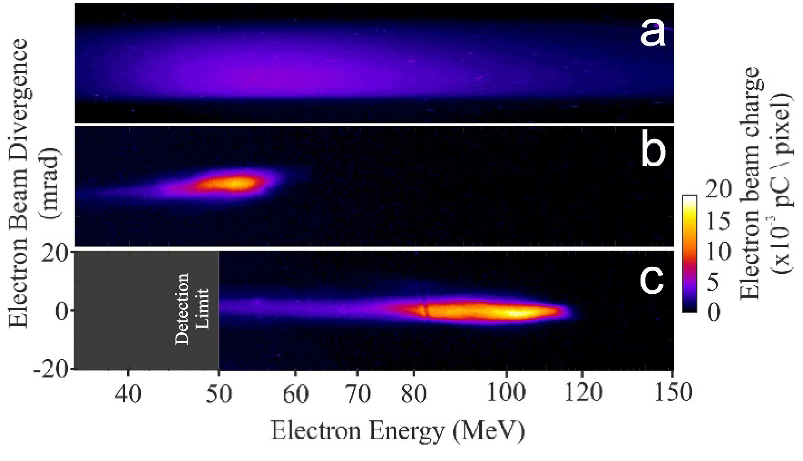
0.8 mm cylindrical nozzle: Sharp gas column, density up to 2×10¹⁹ cm⁻³, quasi-monoenergetic electrons at 50 MeV
-
3 mm conical nozzle: Trapezoidal profile, density 2×10¹⁸ cm⁻³, electron energies exceeding 100 MeV (ΔE/E ≈ 34%)
-
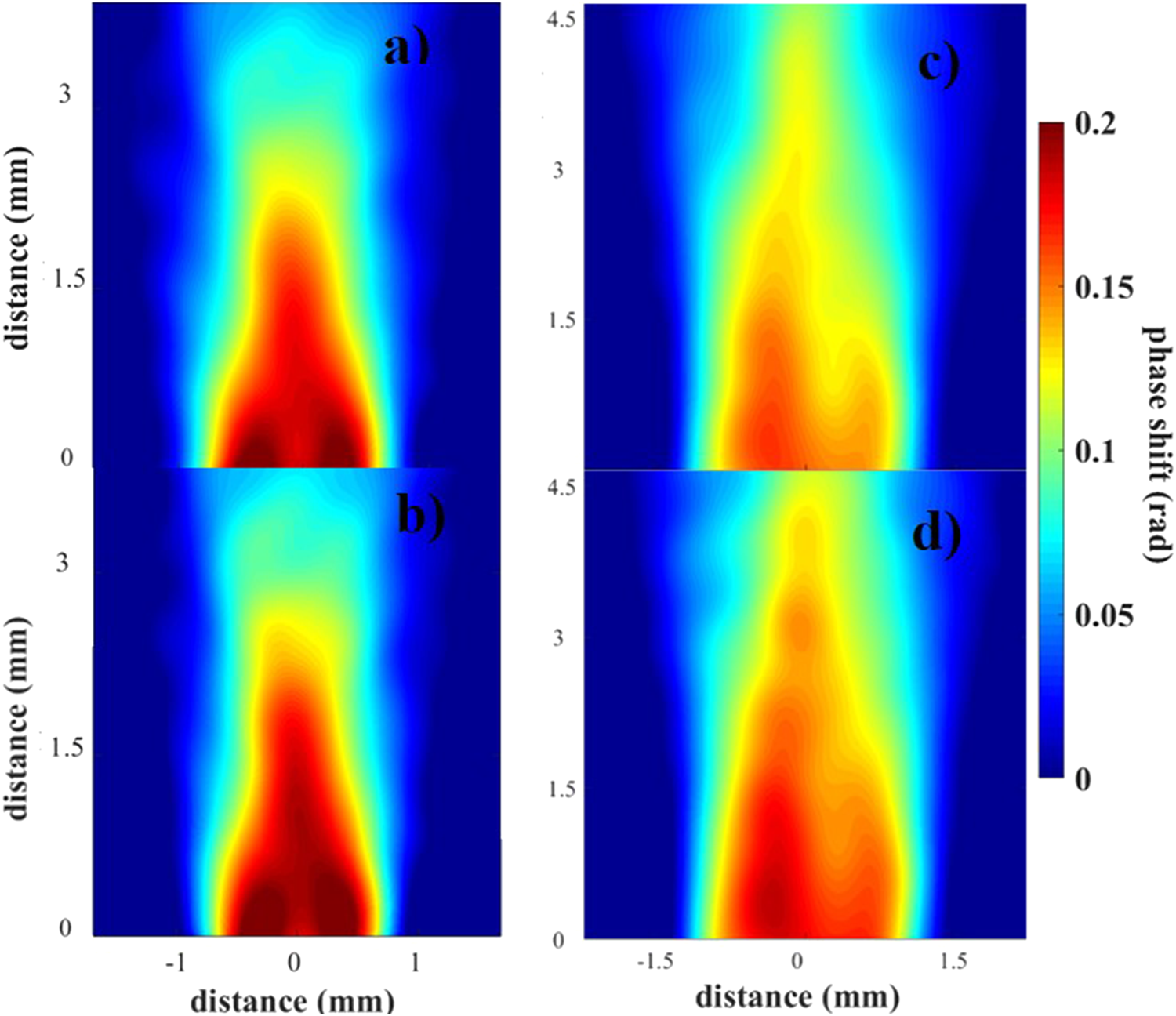
3D-printed nozzles: Custom-designed via CFD simulations with integrated inner valve geometry
-
Five nozzle geometries developed for different density profiles (cylindrical, conical, De-Laval)
-
Good agreement between CFD simulations and interferometric measurements
Laser Chirp Control
-
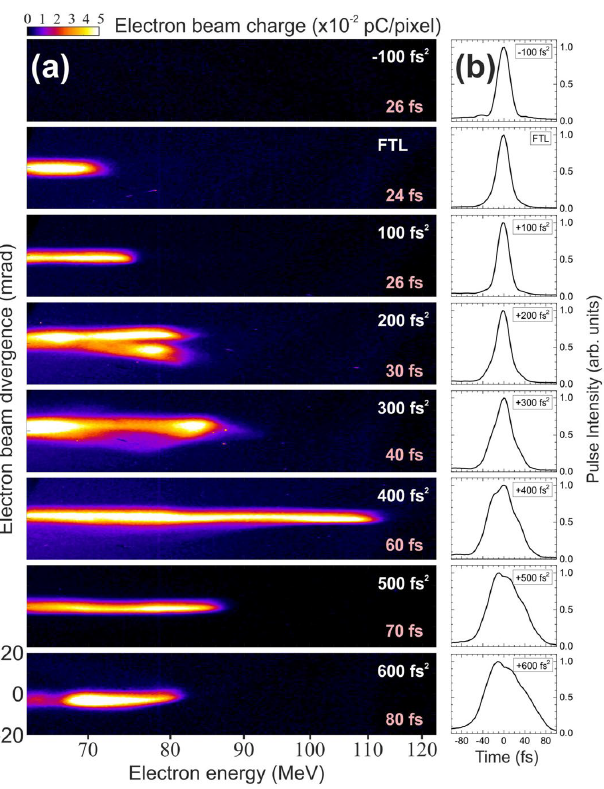
Positive chirp (+400 fs²) increases maximum electron energy by >50% compared to FTL pulses
-
Negative chirp produces electrons below 60 MeV detection threshold
-
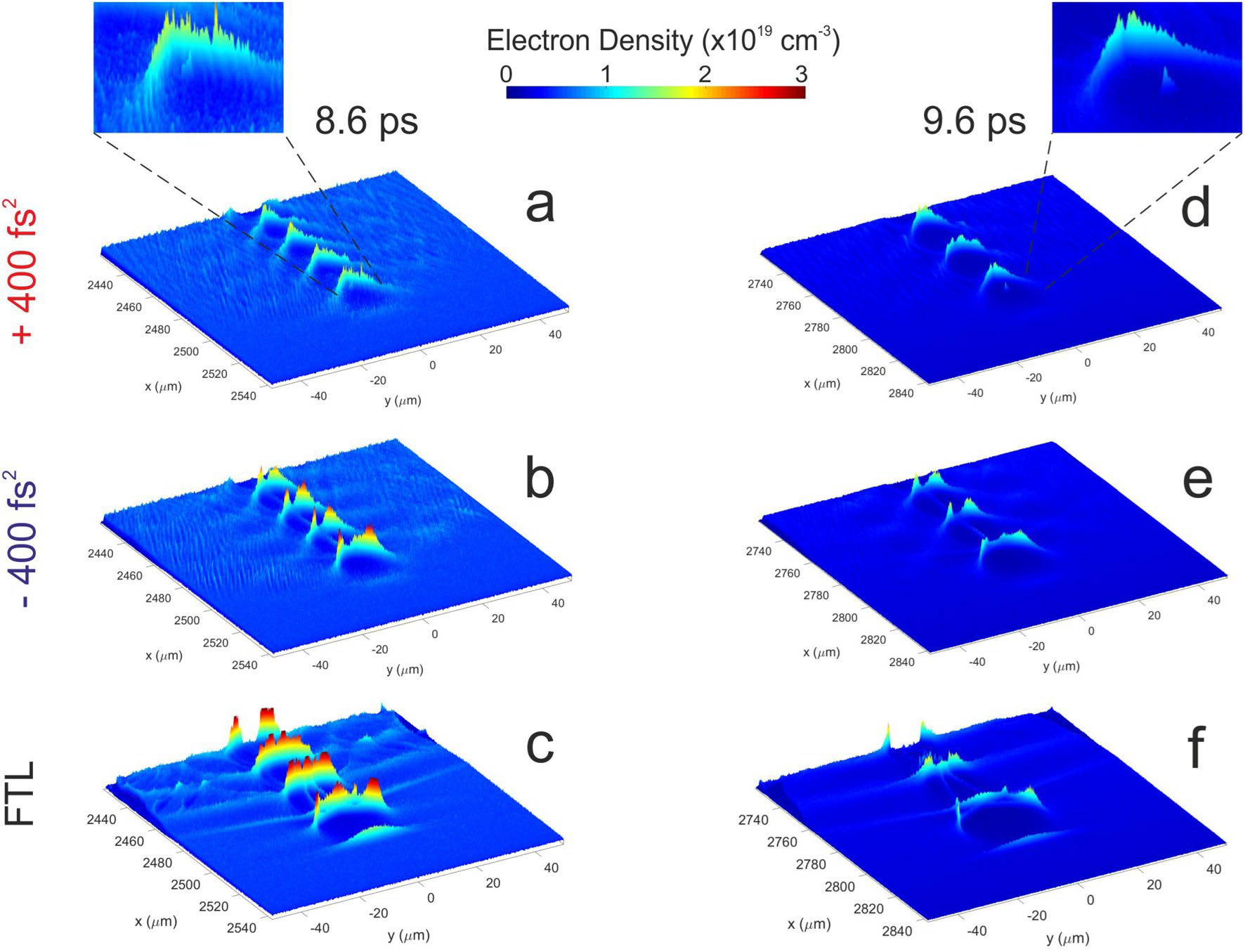
Positively chirped pulses create smoother plasma bubbles favoring electron injection at rear end
-
Optimum chirp value scales with plasma density (higher density requires higher positive chirp)
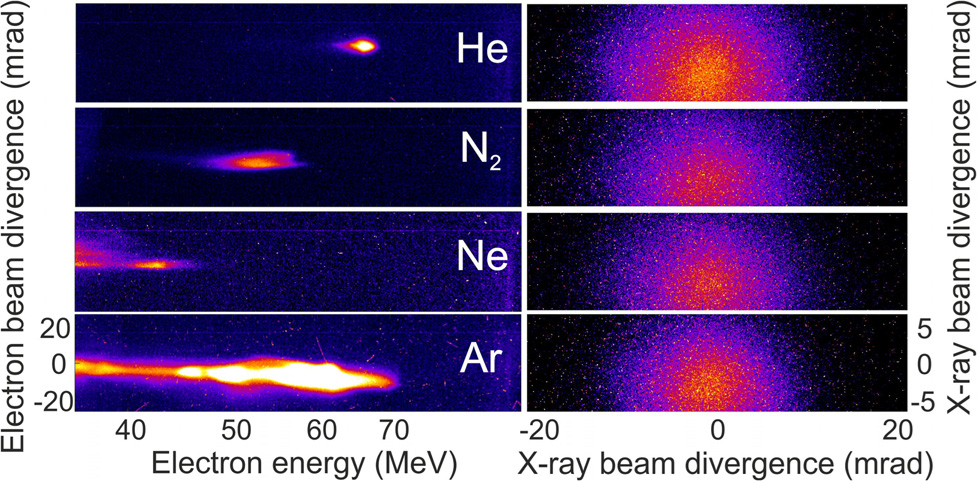
Multi-Electron Gas Targets (He, N₂, Ne, Ar)
-
He: Fully ionized before laser peak, clear bubble formation, self-injection
-
N₂: 5 electrons ionized at leading edge, lower X-ray efficiency due to density distortions
-
Ne: 8 electrons progressively added, behavior similar to He
-
Ar: Highest betatron X-ray efficiency (tunneling ionization of Ar¹³⁺ after laser peak)
-
Ionization injection mechanism enhances electron number inside bubble
Betatron X-ray Radiation
-
Simultaneous recording of electron spectra and X-ray profiles
-
Number of X-ray photons increases with the laser strength and electron energy following a power law
-
X-ray beam divergence decreases as electrons become more energetic, typically ranging from several to tens of milliradians
-
Multi-electron targets (Ar) show 3× higher X-ray efficiency than He
Examples
PIC Simulation: Bubble Formation. Formation of bubble plasma density for FTL pulses as well as positively and negatively chirped pulses at PIC evolution times of 8.6 ps and 9.6 ps. A smoother plasma density bubble is evident for the positively chirped pulses that promotes the wavebreaking and subsequent acceleration of the electron beam.
Electron Spectra: Nozzle Comparison. Typical electron spectra using (a) the 0.8 mm cylindrical nozzle without the absorber, (b) the 0.8 mm cylindrical nozzle with the absorber and (c) the 3 mm conical nozzle with absorber. Cylindrical nozzle produces quasi-monoenergetic beam at 50 MeV; conical nozzle produces broadband spectrum exceeding 100 MeV.
Interferometric phase shift measurements of two 3D-printed nozzles (Nozzle 1 and Nozzle 2) at backing pressures of 40 bar and 50 bar. Nozzle 1 demonstrates superior flow symmetry, attributed to better print quality.
Multi-Electron Gas Targets. X-ray photon number vs maximum electron energy for He, N₂, Ne, Ar. Ar shows highest efficiency due to tunneling ionization of inner-shell electrons after laser peak.
Selected publications
Ong, J.F., Berceanu, A.C., Grigoriadis, A., Andrianaki, G., Dimitriou, V., Tatarakis, M., Papadogiannis, N.A., Benis, E.P. (2024). Non-linear QED approach for betatron radiation in a laser wakefield accelerator. Scientific Reports, 14, 605. https://doi.org/10.1038/s41598-023-50030-6
Grigoriadis, A., Andrianaki, G., Tazes, I., Dimitriou, V., Tatarakis, M., Benis, E.P., Papadogiannis, N.A. (2023). Efficient plasma electron accelerator driven by linearly chirped multi-10-TW laser pulses. Scientific Reports, 13, 2918. https://doi.org/10.1038/s41598-023-28755-1
Andrianaki, G., Grigoriadis, A., Skoulakis, A., Tazes, I., Mancelli, D., Fitilis, I., Dimitriou, V., Benis, E.P., Papadogiannis, N.A., Tatarakis, M., Nikolos, I.K. (2023). Design, manufacturing, evaluation, and performance of a 3D-printed, custom-made nozzle for laser wakefield acceleration experiments. Review of Scientific Instruments, 94, 103309. https://doi.org/10.1063/5.0169623
Grigoriadis, A., Andrianaki, G., Tatarakis, M., Benis, E.P., Papadogiannis, N.A. (2023). The role of laser chirp in relativistic electron acceleration using multi-electron gas targets. Plasma Physics and Controlled Fusion, 65, 044001. https://iopscience.iop.org/article/10.1088/1361-6587/acbb25/meta
Grigoriadis, A., Andrianaki, G., Fitilis, I., Dimitriou, V., Clark, E.L., Papadogiannis, N.A., Benis, E.P., Tatarakis, M. (2022). Improving a high-power laser-based relativistic electron source: The role of laser pulse contrast and gas jet density profile. Plasma Physics and Controlled Fusion, 64, 044007. https://doi.org/10.1088/1361-6587/ac4b06
Grigoriadis, A., Andrianaki, G., Tatarakis, M., Benis, E.P., Papadogiannis, N.A. (2021). Betatron-type laser-plasma x-ray sources generated in multi-electron gas targets. Applied Physics Letters, 118, 131110. https://doi.org/10.1063/5.0046184