Participation of the Institute of Plasma Physics and Lasers of the Hellenic Mediterranean University in the European Project 101046458 — TECHNO-CLS of the HORIZON European Innovation Council (EIC) Pathfinder
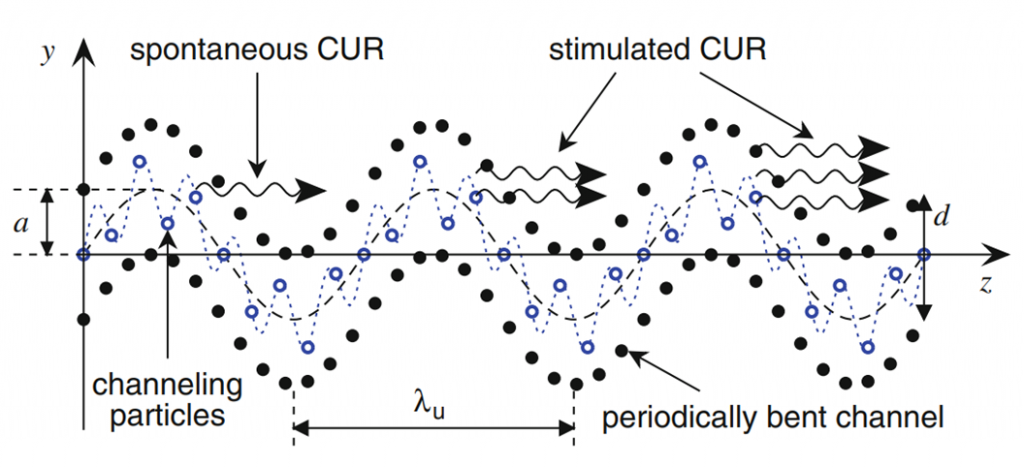
TECHNO-CLS project aims at the breakthrough in technologies needed for designing and practical realisation of novel gamma-ray Light Sources (LS) operating at photon energies from ~100 keV up to GeV range that can be constructed through exposure of oriented crystals (linear, bent and periodically bent) to the beams of ultra-relativistic charged particles. The TECHNO-CLS high-risk/high-gain science-towards-technology breakthrough research programme will address the physics of the processes accompanying the oriented crystal exposure to irradiation by the high-energy electron and positron beams at the atomistic level of detail needed for the realisation of the TECHNO-CLS goals.
To achieve dynamic shaping of the crystal structure, special innovative methods will be developed, based on the generation of acoustic waves produced by piezoelectric transducers and/or pulsed lasers.
Partners
Project coordinator of the Hellenic Mediterranean University is Professor Nektarios Papadogiannis, while the members of the coordinating committee of IPPL Michael Tatarakis and Vasilis Dimitriou also participate.
European Commission’s Innovation Radar
The HMU technology developed under the TECHNO-CLS project (Horizon Europe EIC Pathfinder) has been recently recognized by the European Commission’s Innovation Radar as a high-potential innovation for applications in fundamental research, nuclear technology, and medicine.
Innovation Radar: “Acoustic Wave Crystalline Undulators for tunable γ-ray generation”. https://innovation-radar.ec.europa.eu/innovation/63722
Innovation Radar: “Nanosecond laser interferometer system and phase imaging technology for characterization of CLS based on travelling acoustic waves”. https://innovation-radar.ec.europa.eu/innovation/63723
Publications
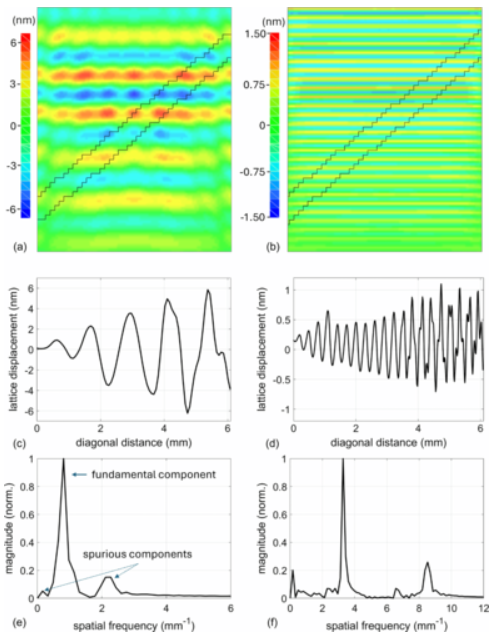
A new method to generate tunable, narrowband gamma-ray radiation by sending ultrarelativistic positrons through a crystal shaken by high-frequency sound waves was proposed. In a study published in Physical Review Accelerators and Beams, the team describes how a piezoelectric transducer excites longitudinal acoustic waves in a silicon crystal along one direction, causing the crystal lattice to periodically bend. When a beam of very fast positrons enters the crystal at an angle and travels along a different set of atomic planes, the bent lattice forces the particles to follow a wiggling path. This motion makes the positrons emit undulator radiation in the (MeV) gamma-ray range. Using a combination of finite element simulations and relativistic molecular dynamics, the acoustic strains inside the crystal, the resulting bending profiles, and the positron trajectories were calculated. The results show a strong, narrow peak in the emitted radiation at a frequency determined by the bending period—demonstrating that this acoustically driven crystalline undulator is both feasible and promising for compact, tunable gamma-ray sources.
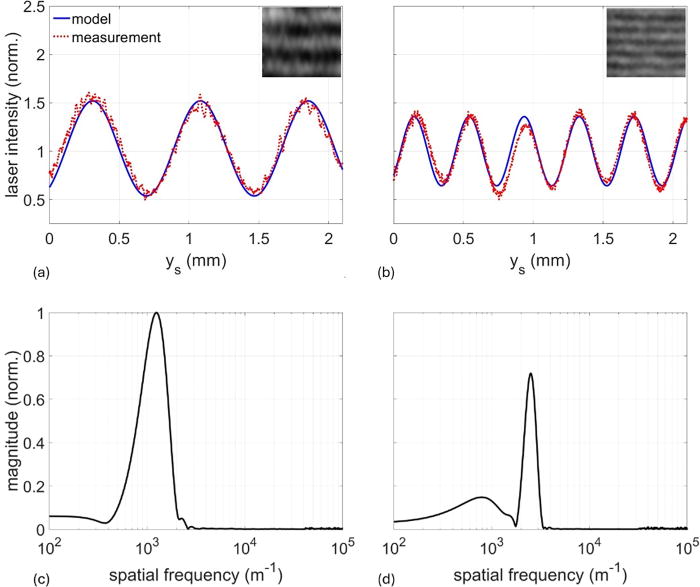
A complete method to precisely characterize the acoustic field inside crystals driven by high-frequency ultrasound waves—a key step toward creating tunable, narrowband gamma-ray sources was developed. As described in The Journal of the Acoustical Society of America, the team uses a piezoelectric transducer to generate millions-of-cycles-per-second sound waves inside a silicon crystal. When ultra‑relativistic charged particles (like positrons) pass through the crystal, they get trapped between the vibrating atomic planes. The periodic motion caused by the sound waves makes the particles undulate and emit gamma radiation in a controlled, narrow band. To measure the acoustic field inside the crystal with high precision, the researchers use fast laser refraction imaging: they direct a laser through the crystal and analyze how the sound waves reshape the laser's intensity pattern. They also developed a dedicated computational model to estimate the pressure and lattice deformation inside the material. Together, these tools provide a reliable framework for designing and building next‑generation gamma‑ray sources at high‑energy research facilities, with potential applications in nuclear science and advanced technologies.